
The BDR Is Now on Display: How AI Is Changing Sales Prospecting
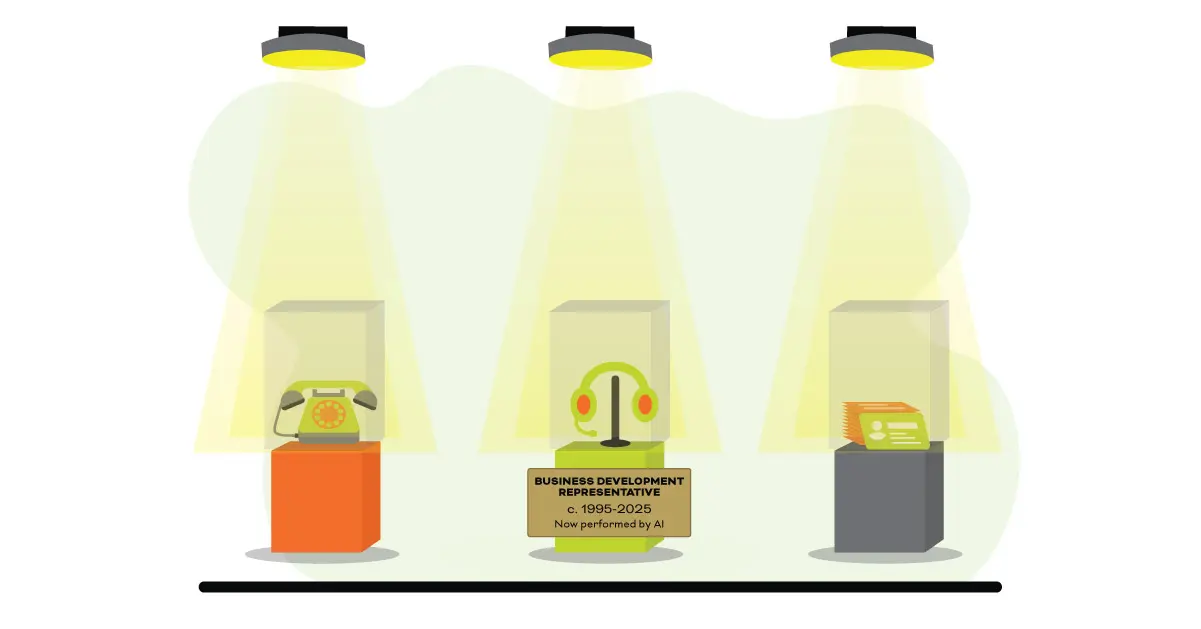
BDR (Business Development Representative) was made to solve scaling gaps, but now that issue has been resolved with AI. For years, BDR teams were built around a simple premise: generate enough activity, and opportunities will follow. More emails. More calls. More LinkedIn messages. More sequences.
That model is rapidly becoming obsolete.
The traditional Business Development Representative (BDR) role emerged because finding buyers and personalizing outreach at scale was difficult and expensive. Today, artificial intelligence is removing those barriers. AI can identify buying signals, prioritize accounts, generate personalized messaging, and execute outreach faster and more consistently than even the best sales development teams.
The result isn't just a more efficient process. It's a fundamental shift in how companies create a pipeline.
Key Takeaways:
- AI now identifies buying intent through behavioral signals, removing the need for manual prospect research.
- Personalization at scale is no longer limited by human capacity—AI can generate unique outreach for thousands of prospects.
- The BDR role isn't disappearing; repetitive prospecting work is, shifting human focus to strategy and relationship-building.
- Sales teams that act on intent fastest will outperform those still optimizing for outreach volume.
Intent Has Become the New Prospect List
Historically, outbound sales began with a list. Companies purchased databases, segmented accounts, and assigned BDRs to contact prospects with messaging tailored to broad personas.
The challenge was obvious: most prospects weren't actively looking for a solution.
AI changes the equation by focusing on intent rather than demographics.
Modern AI platforms can analyze hundreds of signals, including website engagement, content consumption, search behavior, technology adoption, hiring activity, funding announcements, and competitive research. These signals help identify organizations that are actively evaluating solutions before they ever fill out a form.
Instead of asking, "Who should we contact?" companies can now ask, "Who is already showing signs of buying?"
AI sales prospecting dramatically improves your company’s efficiency and conversion rates.
Personalization No Longer Requires Human Labor
The traditional argument for working with BDRs has always been personalization.
A skilled representative could research an account, understand business challenges, and craft a relevant message. The problem was scale. Personalizing outreach for thousands of prospects was impossible without large teams.
AI has effectively solved this problem by automating BDR.
Large language models can now analyze company websites, recent news, executive priorities, content engagement history, and CRM data to create highly relevant outreach in seconds. More importantly, the personalization can be unique for every prospect.
The future isn't sending one message to 1,000 people. It's sending 1,000 unique messages to 1,000 people at a fraction of the cost and time required by human teams.
The Rise of Autonomous Pipeline Generation
The next evolution of AI automation goes beyond writing emails.
AI systems are increasingly capable of managing the entire top-of-funnel process. They can identify intent signals, score opportunities, create outreach sequences, optimize messaging, trigger campaigns across channels, and continuously learn from performance data.
This creates an autonomous pipeline generation engine that operates continuously. Human involvement shifts from execution to oversight, strategy, and relationship management.
The highest-performing sales organizations will not be the ones with the largest BDR teams. They will be the organizations that combine AI-driven intelligence with human expertise at the moments where trust, consultation, and complex decision-making matter most.
What This Means for Sales Leaders
Let’s be clear: the death of the BDR does not mean the death of sales. It means the death of repetitive prospecting work—automating the process to make it easier for sales to be effective.
Sales leaders should be asking difficult questions:
- Why are people manually researching accounts that AI can analyze in seconds?
- Why are teams sending generic sequences when AI can create individualized outreach?
- Why are organizations paying for activity when they could optimize for buying intent?
The organizations that answer these questions first will gain a significant competitive advantage.
The Future Belongs to Intent-Driven Revenue Teams
The most important shift is not technological—it's strategic.
Revenue teams have spent decades trying to create demand through volume. AI enables a different approach: identifying demand that already exists and engaging buyers with relevance at precisely the right moment.
The winners in the next generation of sales will not be those who send the most messages. They will be those who understand intent the fastest and respond with the greatest relevance.
The BDR role was created to solve a scaling problem. AI is solving that problem.
The question is no longer whether AI will transform outbound sales. The question is how quickly organizations will adapt before their competitors do.
The teams that move first will own the buying conversation before anyone else gets there. If your sales org is still running on volume instead of intent, that's the gap worth closing first.